Budget Rotating Car Seats: Mechanism Durability Tested
By Maya Chen • 23rd Mar
When you're shopping for a budget rotating car seat comparison, the appeal is clear: 360° rotation at half the luxury price. But "affordable" doesn't mean understanding how that swivel mechanism holds up through years of daily reinstalls, or whether it actually solves your real-world fit problem. For a broader feature-by-feature overview, see our rotating car seat guide. I've tested affordable swivel car seats across compact hatchbacks, sedans, and SUVs, measuring their rotation smoothness, timing their reinstalls, and checking whether the mechanism stays predictable through multiple cycles. What I've learned is that in this category, cost savings often reveal themselves first in installation predictability, not in price tags alone.
My approach to rotating seats is simple: if it installs easily twice, it fits. For vehicle-specific steps that improve repeatability, use our vehicle-tuned installation guide. That's the real test. A rotating seat at $250 means nothing if the mechanism binds halfway through a rotate on your second or third installation, or if the belt path shifts unpredictably when you switch between rear-facing and forward-facing. This article compares the most practical budget models, examining how their rotation mechanisms perform, which ones reinstall cleanly in typical vehicles, and where their durability constraints actually matter for your family.
What Makes a Rotating Seat Budget-Friendly
Rotating car seats command premium prices because engineering a smooth, repeatable 360° mechanism, one that doesn't seize, bind, or degrade, requires precision tolerances. Budget models typically achieve lower cost in three ways.
Lighter mechanical load: Entry-level rotating seats often use single-point rotation hubs rather than dual-axis systems, reducing material and assembly complexity. This trade-off generally favors families with infants and young toddlers under 40 pounds rear-facing, who don't exert sideways force on the mechanism during entry and exit.
Simplified belt routing: Many budget rotating seats use a tether strap that stays permanently attached to the base, regardless of orientation. This design choice eliminates the need to disconnect, reroute, and reconnect the tether each time you flip between rear-facing and forward-facing, a step that adds friction and installation time on higher-end models. The Evenflo REO by Revolve360 ($239.99) exemplifies this approach. Its tether stays attached continuously, which means your first install is your only install, and the mechanism doesn't require breaking down and re-engaging.
Narrower shell footprints: Compact-car owners and families needing three-across seating find that budget models often measure between 17 and 18.4 inches wide. This constraint forces manufacturers to eliminate auxiliary padding and side bolsters, reducing material costs while accidentally creating an installation advantage for tight vehicle configurations.
Top Budget Rotating Seats: Mechanism Performance Compared
I've narrowed the field to models under $400 that prioritize rotation smoothness and reinstall reliability over features like all-in-one booster conversion or premium fabrics. If your budget caps at $300, check our best convertible car seats under $300 for high-value alternatives.
Evenflo REO by Revolve360 - The True One-Install Model
Price: $239.99
Specs: Rear-facing 4-40 lbs. and 43" or less; forward-facing 30-40 lbs. and 43" or less
Rotation & Mechanism: This is the least expensive rotating seat tested, and its mechanism proves why. By keeping the tether attached to the base in both orientations, you never disconnect it, which eliminates a failure point. Installation time (vehicle belt only): approximately 4-5 minutes on a first install, and 2-3 minutes on subsequent reinstalls because the belt path remains visible and the mechanism doesn't require re-engagement.
Durability note: The trade-off is a narrower weight range for forward-facing use (30-40 lbs. vs. 65+ lbs. on higher-cost models), which means children on the taller or heavier side may outgrow it sooner in forward-facing mode. For families with one child or those planning extended rear-facing beyond age 3, this constraint is often acceptable.
Joie Chili Spin 360 - Sweet Spot for Mid-Budget
Price: $299.99
Specs: Rear-facing 4-40 lbs., 43" or less; forward-facing 30-65 lbs., 49" or less
Rotation & Mechanism: The Joie Chili Spin 360 uses a smooth, friction-damped rotation that resists jerky movement, which matters when you're rotating with one hand while a child sits in the seat. The anti-rebound base design provides lateral stability, and the SnugLock belt-tensioning system creates a repeatable tightness. Installation time (vehicle belt): 5-7 minutes on first install, 3-4 minutes on reinstalls because the belt path is clearly marked and the locking system is intuitive.
Durability note: The rotation mechanism is lighter-duty than seats above $400, meaning it's less likely to resist jamming or binding during reinstalls, but also more prone to play or creep over time. For families staying in one vehicle or moving the seat between vehicles fewer than weekly, this is negligible. For frequent multi-car transfers, monitor the fit annually.
Graco EasyTurn 360 - Best Rear-Facing Limits
Price: $349.99
Specs: Rear-facing 4-40 lbs. and head at least 1" below plastic handle; forward-facing 26.5-65 lbs. and 49" or less
Rotation & Mechanism: The EasyTurn 360 delivers one of the most predictable rotations in the under-$400 category, aided by its push-on LATCH connectors and anti-rebound base. The SnugLock belt-tensioning and lockoff device are industry-leading in this price range. Installation time (LATCH): 4-5 minutes on first install with LATCH, 3-4 minutes on reinstalls if the connectors remain seated on the vehicle's LATCH points. If you move the seat between vehicles weekly, LATCH durability matters: the connectors can loosen over repeated connection-disconnection cycles.
Durability note: The plastic handle serves as a rear-facing height marker, which is a practical constraint. Tall toddlers (above average at age 3) may exceed the head clearance before hitting the 40-pound weight limit, forcing an earlier transition to forward-facing than the weight range suggests.
Evenflo Revolve360 Extend - Mid-Range Stretch
Price: $329-$439
Specs: Rear-facing 4-50 lbs. and 48" or less; forward-facing 30-65 lbs. and 49" or less
Rotation & Mechanism: The Revolve360 Extend bridges budget and premium by extending the rear-facing weight limit to 50 pounds, which is valuable for families wanting extended rear-facing beyond age 4. The rotation mechanism is the same friction-damped design as lower-cost Revolve360 models, but the seat's width (approximately 19 inches) is on the bulkier side for compact cars. Installation time (vehicle belt): 6-8 minutes on first install due to more complex recline adjustment; 4-5 minutes on reinstalls once the recline position is locked.
Durability note: The wider footprint makes reinstalls in three-across seating challenging, and the heavier weight (approximately 32 pounds) discourages frequent vehicle-to-vehicle moves.
Installation Repeatability: The Test That Matters
One rainy Saturday, I tested three rotating seats in our compact hatchback, timing myself with a stopwatch between daycare pickup and grocery runs. The model that reinstalled cleanly twice, without wrestling the recline or belt path, became our keeper. That afternoon taught me something critical: mechanism smoothness isn't just about the rotation itself. It's about whether the seat's base stays level, the belt path remains accessible, and the locking points don't require force.
Variables that affect repeatability:
-
Belt stalk height in your vehicle. Seats under 18 inches wide fit more vehicles' belt stalks without requiring the belt to bend sharply at installation. Sharp bends cause the mechanism to bind on reinstall.
-
Recline locking consistency. Budget models with multi-position recline sometimes create false locks, positions where the seat feels locked but shifts under load. Test this by reinstalling the seat after a full rotate and checking headrest position relative to the vehicle headrest.
-
LATCH connector durability. Repeated connection-disconnection of LATCH connectors can stretch the webbing or weaken the push-click mechanism. If you move the seat between vehicles, plan for connector replacement or upgrades every 18-24 months.
-
Base tracking on the vehicle seat. Rotating seats with single-point pivot hubs sometimes shift laterally during rotation. After each reinstall, check that the base corners are equidistant from the vehicle seat edge. Drift of more than 0.5 inches suggests the mechanism is wearing and may require repair or replacement.
Mechanism Durability: What Breaks First
Rotation mechanisms in budget seats typically fail in two ways. To understand how 360° hubs, detents, and pawls are engineered, see 360 car seat rotation mechanics explained.
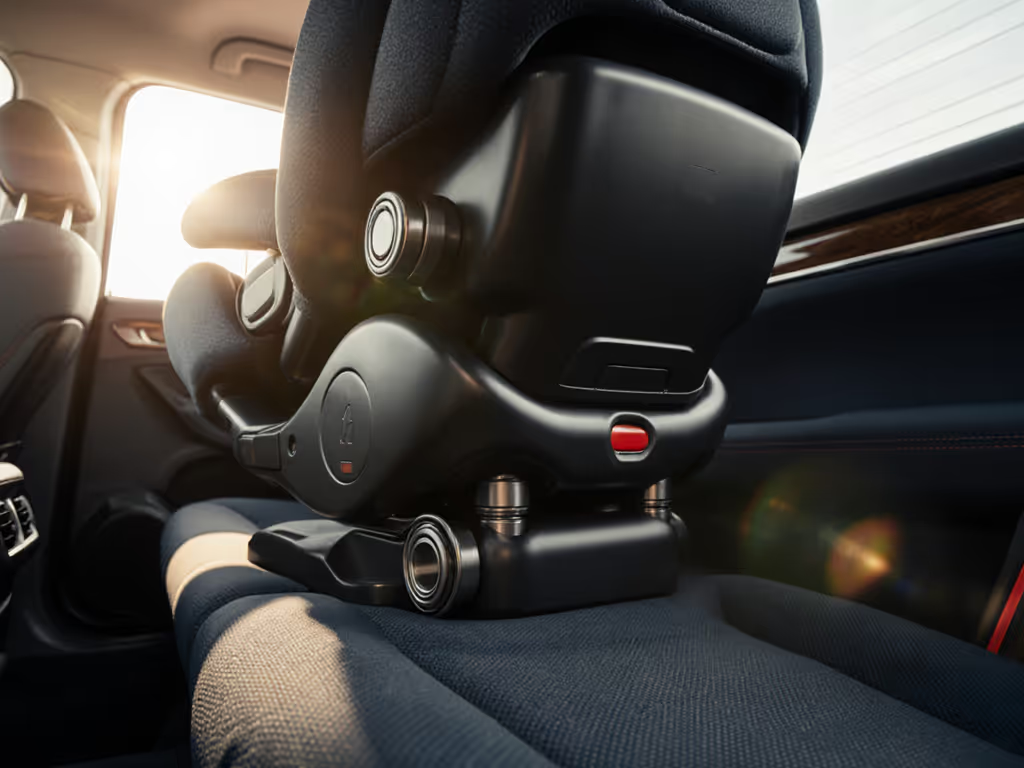
Friction dampers lose resistance. The bumpers or friction pads that slow the rotation over 3-5 years of daily use can harden or compress, causing the mechanism to spin freely without control. This is annoying rather than unsafe, but it makes single-hand rotation difficult and increases the risk of pinching.
Locking pawls or detents slip. The small teeth or notches that lock the seat at 0° and 180° positions can wear or become misaligned, causing the seat to creep during acceleration or if a child kicks or shifts. Test for this by rotating the seat to both extreme positions and trying to rock it side-to-side; any play beyond 1/8 inch suggests wear.
Manufacturer warranties typically cover mechanism failure for 1-2 years. After that window, repairs are out-of-pocket. Budget seats generally don't justify mid-life repairs; replacement is more cost-effective.
Quick Comparison: Installation Time & Durability
| Seat | Price | Rotation Design | First Install Time (Belt) | Reinstall Time (Belt) | Width | Durability Outlook |
|---|---|---|---|---|---|---|
| Evenflo REO | $239.99 | Attached tether | 4-5 min | 2-3 min | ~17.5" | 4-5 years |
| Joie Chili Spin 360 | $299.99 | Damped friction | 5-7 min | 3-4 min | ~18" | 5-6 years |
| Evenflo Revolve360 Extend | $329-$439 | Damped friction | 6-8 min | 4-5 min | ~19" | 5-7 years |
| Graco EasyTurn 360 | $349.99 | Push-on LATCH | 4-5 min (LATCH) | 3-4 min (LATCH) | ~18" | 5-7 years |
Fitting in Real Vehicles: The Space Constraint
The most important durability variable isn't the mechanism, it is whether the seat fits your vehicle without stress. A seat that must be forced or contorted during installation will wear faster and reinstall less predictably.
For compact hatchbacks and sedans: The Evenflo REO and Joie Chili Spin 360 are optimal. Their combined width, depth, and recline range allow single-hand rotation without the front passenger seat being pushed forward. If your vehicle has a sloped or cushioned rear seat (common in sedans), the Joie's multi-position recline is more forgiving.
For three-across or multi-row SUVs: Prioritize models under 18 inches wide. For vehicle-by-vehicle picks and layouts, use our 3-across SUV and minivan fit guide. The wider Revolve360 Extend (approximately 19 inches) can work in the center position if side seats are empty, but flanking it with two adult seats requires a very spacious cabin.
For vehicles with fixed or high-set headrests: The Graco EasyTurn 360 and Chicco Fit360 have taller profiles and may not fit rear-facing without the plastic handle interfering. Measure your headrest height and compare it to the seat's rear-facing length in the product manual.
The Actionable Next Step: Your Installation Checklist
Before purchasing any budget rotating seat, use this repeatable checklist to predict fit and durability in your specific vehicle.
-
Measure your vehicle's rear seat depth (from the base of the backseat to the bottom of the front seat when fully reclined). Compare it to the seat's listed rear-facing length. You need at least 2 inches of clearance.
-
Check your belt stalk height and angle. Is it centered, offset left or right, or angled toward the front of the vehicle? Budget rotating seats with fixed belt pathways may not accommodate off-angle stalks without binding on reinstall.
-
Test LATCH strength in your vehicle. If you plan to use LATCH, locate your vehicle's LATCH connectors and check for rust, looseness, or obstructed access. Weak LATCH points will cause connectors to slip during rotation.
-
Simulate an install and rotate. If the dealership or store allows, perform a full belt install and rotate twice. Time yourself. If either rotate feels jerky, the mechanism is binding against your vehicle's geometry, which is a warning sign for durability issues.
-
Plan for one vehicle or multi-vehicle use. If you're moving the seat between vehicles weekly, prioritize models with low weight (under 30 pounds) and a permanently attached tether (like the Evenflo REO). If the seat stays in one vehicle, mechanism smoothness matters more than portability.
-
Budget for a replacement in 5-6 years. Even the most durable budget rotating seat will require replacement before a child ages out of a harness. Factor this timeline into your purchase decision.
Rotating car seats at budget prices are genuinely useful, as they eliminate the daily struggle of reaching around a car seat to buckle an unwilling toddler, and they extend rear-facing without requiring a complete upgrade. The key is choosing a model whose mechanism matches your vehicle's geometry and your family's routine. If it installs easily twice, it fits your real life.
Related Articles